















This is going to sound a bit strange, but have you ever just sat there and looked at a number? Not a price tag or a phone battery percentage, but the actual idea of a number?
It’s easy to think of math as this cold, dusty subject we were forced to learn in classrooms with flickering fluorescent lights. But honestly? Numbers are probably the closest thing to actual magic humans have ever stumbled upon. They aren’t just symbols; they’re the literal architecture of our reality. They’ve toppled empires, built cathedrals, and—let’s be real—probably caused more than a few existential crises along the way.
Think about it. Before we had a way to count, the world was just a blur of “some” or “many.” You didn’t know if you had enough grain to survive the winter; you just hoped for the best. Numbers gave us a grip on the universe. They let us measure the stars and, eventually, find our way across oceans.
So, grab a coffee. Let’s take a walk through ten specific numbers that didn’t just change the way we do math—they changed what it means to be human.
1. Zero: The Beautiful Nothing
Let’s start with the big one. The void. The goose egg.
For a long time, humans were terrified of zero. It makes sense, right? How can “nothing” be “something”? The Greeks, brilliant as they were, pretty much ignored it because it felt philosophically dangerous. They were all about geometry and things you could touch. You can’t touch a hole in the air.
But then, over in India, some absolute geniuses realized that zero isn’t just a placeholder; it’s a destination. It’s the balance point. Without zero, we’re stuck with basic counting. With zero, we get the decimal system. We get calculus. We get the ability to represent the emptiness between stars.
Think about your bank account. That “0” at the end of a hundred makes it a thousand. It’s a force multiplier. It’s the silence between notes that makes the music work. Honestly, zero is the humblest number, but it carries the weight of the entire world on its back.
Interesting Fact: The word "zero" actually comes from the Arabic sifr, which also gave us the word "cipher." It was seen as a secret code for a long time because the idea of "nothingness" felt so revolutionary.
2. One: The Beginning of Everything
If zero is the void, then One is the Big Bang.
It seems too simple to be revolutionary, doesn’t it? But “One” is the birth of the individual. It’s the moment we stopped seeing the world as a chaotic soup and started pointing at things. “That is one tree.” “This is one spear.”
In a way, One is the loneliest number (shout out to Three Dog Night), but it’s also the most defiant. It’s the unit of existence. Everything we’ve ever built—every skyscraper, every legal code, every TikTok video—starts with a single unit. It represents the self. In philosophy, One is the “Monad,” the source of all things. It’s the point from which the circle is drawn.
When we say someone is “The One,” or we talk about “One World,” we’re tapping into this ancient, mystical power of unity. It’s the number that says, Here I am. I exist.
Interesting Fact: Binary code—the language that literally runs the screen you’re looking at right now, is just a conversation between One and Zero. Every digital photo you've ever taken is just a massive, complex dance of "is it there?" (1) or "is it not?" (0).
3. Pi (π): The Infinite Circle
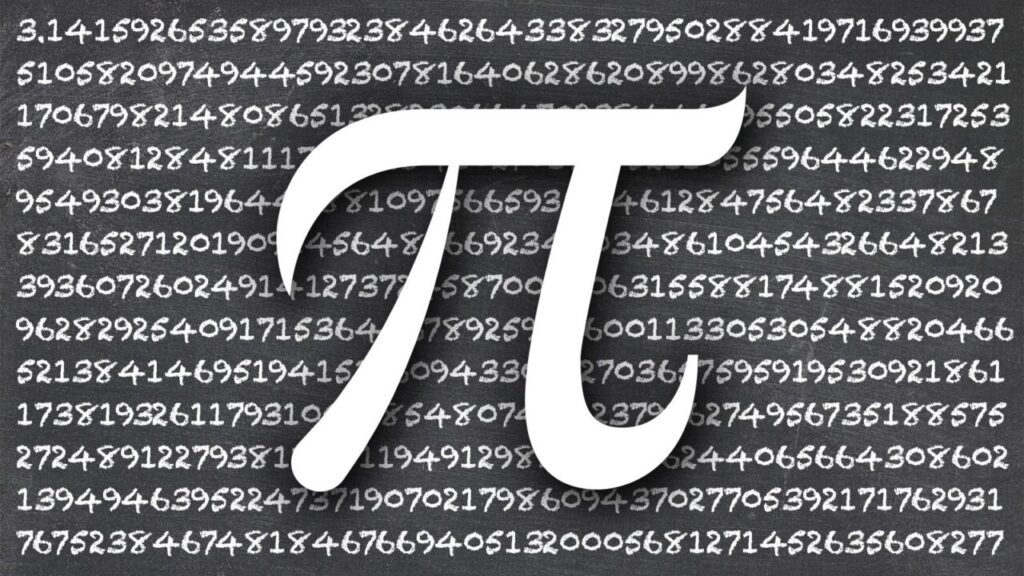
One could say that π is a bit of spiritual number. Namely, it is roughly 3.14. But it’s the “roughly” that’s the kicker. It goes on forever. It never repeats. It never settles down into a predictable pattern. It’s irrational. It’s messy. It’s… well, it’s like life.
But here’s why it changed history: you can’t build anything round without it. If you want to build a wheel that doesn’t wobble, a dome that doesn’t collapse, or a pipe that carries water to a city, you need π. The Egyptians used a version of it for the Pyramids. Archimedes obsessed over it.
Pi is the bridge between the straight lines humans love to draw and the curves that nature actually uses. It tells us that even in something as “perfect” as a circle, there is an infinite, unknowable mystery tucked inside.
Interesting Fact: People have calculated Pi to over 100 trillion digits now. If you printed that out, it would stretch to the moon and back several times. And yet, we only need about 15 digits of π to navigate a spacecraft to another planet with perfect accuracy. The rest is just us humans being obsessive.
4. Seven: The Rhythm of the Soul

Why seven? Why not six or eight?
Seven is everywhere. Seven days in a week. Seven colors in the rainbow. Seven notes in a musical scale. Seven deadly sins. Seven wonders of the ancient world.
It’s a “prime” number, meaning it’s awkward and won’t be divided. But for some reason, the human brain is wired to love it. Historically, the seven-day week changed everything. It gave us a rhythm that wasn’t just tied to the seasons or the years, but to a human-scale heartbeat. It gave us the concept of a “weekend” (eventually), and it gave us a way to organize our lives into manageable chunks.
It’s the number of the seeker. It feels complete, but also a bit mysterious. It’s the number that bridges the gap between the earth (the four corners of the world) and the divine (the holy trinity). Or maybe it’s just the maximum number of things most people can remember in their short-term memory. Either way, it’s the glue of our culture.
Interesting Fact: In ancient times, people could see seven "wandering stars" (planets/celestial bodies) in the sky with the naked eye: the Sun, the Moon, Mars, Mercury, Jupiter, Venus, and Saturn. That’s almost certainly why we have a seven-day week. We were literally timing our lives to the movement of the gods.
5. Sixty: The Keeper of Time

Have you ever wondered why there are 60 seconds in a minute and 60 minutes in an hour? Why not 100? It would be so much easier for our base-10 brains!
You can thank the ancient Sumerians for that one. They loved the number 60. Why? Because you can divide it by almost anything: 2, 3, 4, 5, 6, 10, 12, 15, 20, 30. It’s incredibly “clean” for doing math without a calculator.
Because of 60, we have the 360-degree circle. Because of 60, we can navigate the globe using latitude and longitude. It’s the number that taught us how to slice up time and space into little pieces we could understand. Every time you look at a clock or check your GPS, you’re using 5,000-year-old Sumerian logic. It’s the number that turned the wild, flowing river of time into a series of predictable ticks.
Interesting Fact: The Sumerians didn't count on their fingers like we do (1-10). They used their thumb to count the three joints on each of their other four fingers. Try it. 4 fingers x 3 joints = 12. Then they used the fingers on their other hand to track how many "12s" they had reached. 12 x 5 fingers = 60. Math is literally in your hands.
6. Phi (ϕ): The Golden Ratio
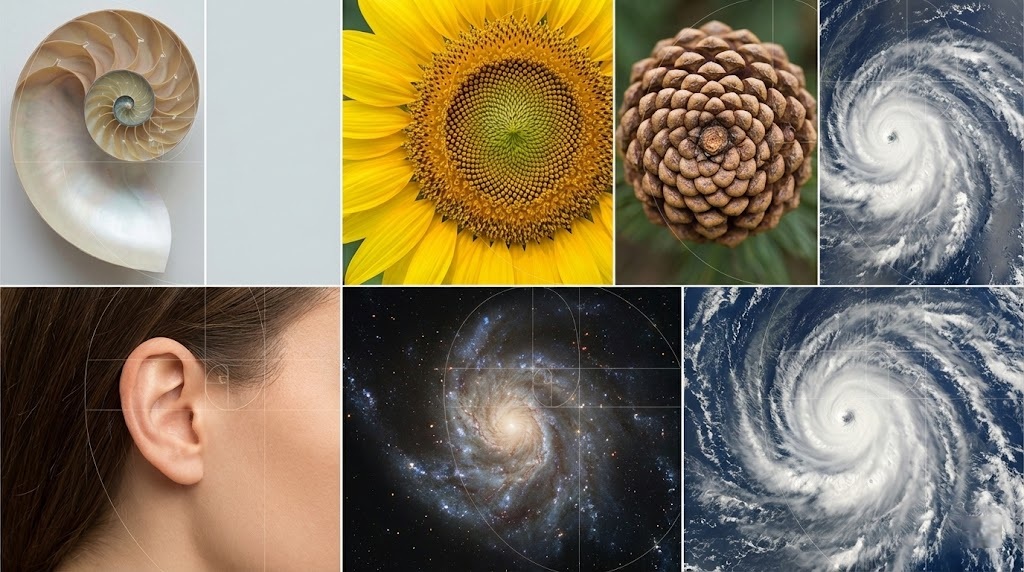
This one is about 1.618, and many people call it the “God Fingerprint.”
If you look at a seashell, a hurricane, or a galaxy, you’ll see a spiral. If you measure the proportions of that spiral, you keep bumping into ϕ. It’s the ratio that feels “right” to the human eye.
Artists like Da Vinci and architects like Le Corbusier obsessed over this number. They believed that if you used this ratio, you were tapping into the fundamental beauty of the universe. It changed history by defining our aesthetic. It’s why the Parthenon looks so stable and why some faces just look “more beautiful” to us. It’s the bridge between biology and geometry. It’s the number that proves there’s a pattern to the chaos.
Interesting Fact: The Fibonacci sequence (1, 1, 2, 3, 5, 8, 13...) is intimately tied to the Golden Ratio. As the numbers get higher, the ratio between them gets closer and closer to 1.618. You can find these numbers in the way petals grow on a flower or the way pinecones are structured. Nature is a mathematician.
7. Twelve: The Divine Dozen

Twelve is the “social” version of sixty.
Think about how often twelve shows up. Twelve months in a year. Twelve signs of the zodiac. Twelve tribes of Israel. Twelve apostles. Twelve jurors. Twelve inches in a foot. Two sets of twelve hours in a day.
Twelve is a “perfect” number for trade. If you have twelve apples, you can split them between 2, 3, 4, or 6 people easily. It’s the number of the marketplace and the courtroom. It’s the number that allowed early civilizations to organize their calendars and their commerce. It’s a number that feels sturdy. It feels like a complete set.
Without twelve, we wouldn’t have had the agricultural cycles that allowed us to stop being nomads and start building cities. We needed to know when the twelfth month was coming so we didn’t starve.
Interesting Fact: The word "dozen" comes from the French douzaine, but the concept is much older. Even today, despite the world mostly moving to the metric system (base 10), we still buy eggs by the dozen. Some traditions are just too deeply baked into our brains to change.
8. Euler’s number (e): The Number of Growth

If you aren’t a math nerd, you might not have heard of e (Euler’s number, roughly 2.718). But I promise you, it’s running your life.
e is the number of “natural growth.” If you want to calculate how a population of bacteria grows, or how your high-interest credit card debt is compounding, you use $e$. It’s the constant that describes things that grow continuously.
It changed history because it allowed us to understand change itself. It’s a pillar of calculus. Without e, we wouldn’t understand radioactive decay, which means no carbon dating, which means we wouldn’t know how old the Earth is. We wouldn’t understand how viruses spread (very relevant lately, right?).
It’s the number that captures the “whoosh” of life moving forward.
Interesting Fact: If you invest $1 at a 100% interest rate compounded continuously for one year, you will end up with exactly e dollars ($2.718...). It’s the absolute mathematical limit of how much "growth" can happen in a set period.
9. 13: The Outcast

Wait, why is 13 on a list of numbers that “changed” history? Because of the power of fear.
13 is the number that isn’t twelve. It’s the one that breaks the perfect circle. It’s the prime number that feels “wrong.” Because of the superstition surrounding 13 (Triskaidekaphobia), we’ve actually altered our physical world.
Think about how many hotels don’t have a 13th floor. Think about how many people won’t get married on the 13th of the month. This number changed history by showing us how much power an idea can have over our behavior. It’s a reminder that humans aren’t purely rational creatures. We are storytellers, and sometimes we tell stories that make us afraid of a simple digit.
It represents the “other,” the outlier, the thing that doesn’t fit. And every society needs an outlier to define what “normal” looks like.
Interesting Fact: The fear of 13 might come from the Last Supper (13 people at the table, and we know how that ended for Jesus) or from the arrest of the Knights Templar on Friday, October 13th, 1307. Or maybe it’s just because it comes right after 12, and 12 is so "perfect" that 13 feels like a messy mistake.
10. Imaginary Unit: The Impossible Number

Let’s end with something that shouldn’t exist.
The “imaginary unit,” is the square root of -1. If you remember middle school math, that’s impossible. You can’t multiply a number by itself and get a negative. It’s a glitch in the Matrix.
But mathematicians decided to use it anyway. They said, “What if we just pretend this exists?” And it turns out, when you use i, the universe starts making way more sense.
i is the foundation of complex numbers. It’s how we describe waves—light waves, sound waves, radio waves. Without i, we wouldn’t have electricity as we know it. We wouldn’t have the internet, or cell phones, or MRI machines. History was changed because we were brave enough to use a number that was “imaginary” to build a very real world.
It’s a beautiful lesson, honestly. Sometimes you have to believe in the impossible to make progress.
Interesting Fact: For a long time, mathematicians hated the imaginary unit number. They called it "useless" and "sophistic." It wasn't until the 1800s that they realized it was the secret key to understanding the entire physical world. It just goes to show that you should not write off an idea just because it sounds crazy at first.